
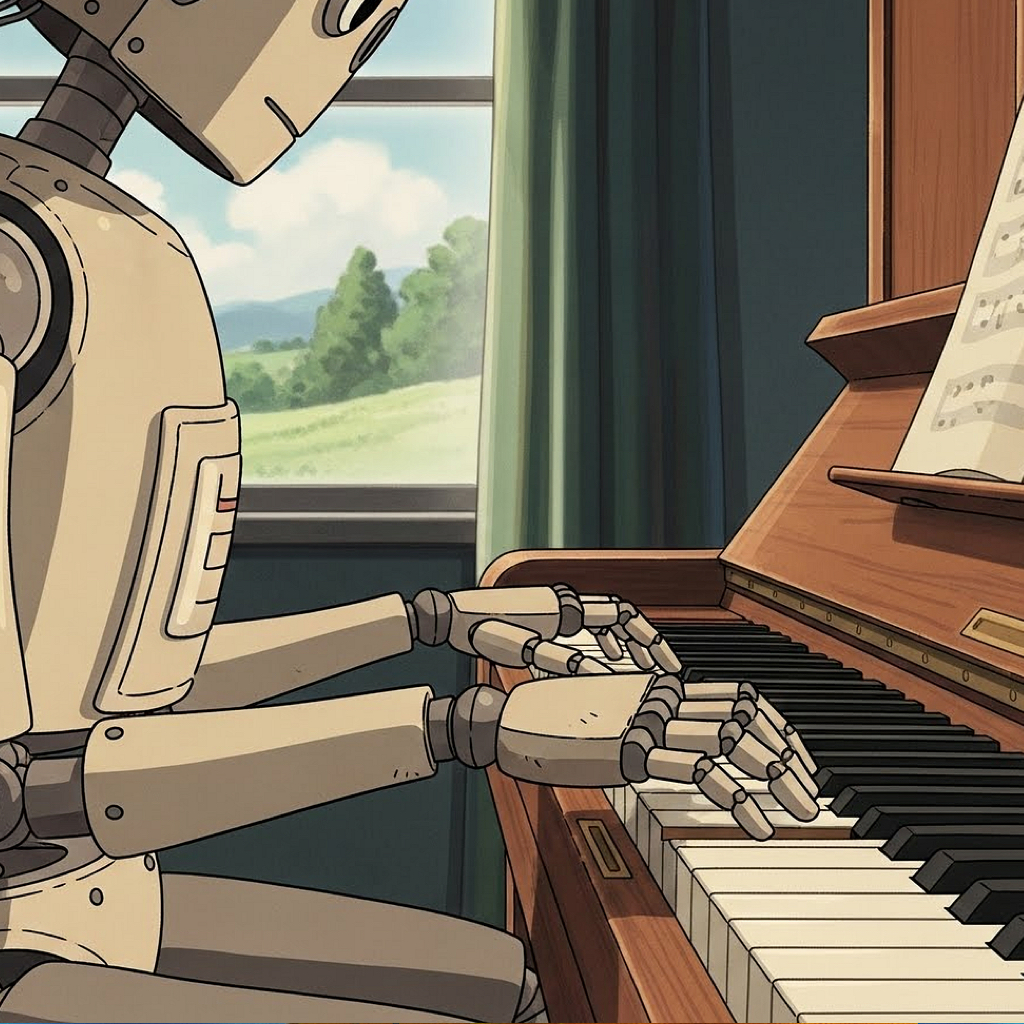
AI can now write a song before your coffee cools. It can hum a melody, stack harmonies, invent lyrics about heartbreak, cosmic love, or nostalgic sunsets in cities it has never actually visited. Press a button and the machine politely hands you a perfectly serviceable piece of music. Sometimes it is even catchy. Sometimes it sounds like a slightly overenthusiastic intern who has listened to too much Spotify and not enough silence.
The question is no longer whether AI can make music. It clearly can. The more interesting question is what kind of music we actually want to make, and who we want in the room when it happens.
Talk to musicians who actually use these tools and you hear something far more nuanced than the usual hype cycle. Some love the speed and surprise. AI helps break creative blocks, sketch rough ideas, or stumble into combinations they might never have tried on their own. Others remain cautious, even uneasy. There are quiet worries about authorship, control, originality, and whether the tool is slowly reshaping how they think about their own creative identity.
In other words, nobody is quite ready to hand the studio keys to the robot.
What seems to be emerging is not a battle between humans and machines, but a negotiation. Creators are not asking for replacement. They are asking for collaboration that respects intention, taste, failure, and the strange emotional logic that lives inside real creative work.
This matters because music is not just pattern generation. It is memory, culture, timing, restraint, and sometimes knowing when not to play the next note. A machine can analyze thousands of chord progressions. It cannot remember the song that played in the kitchen on rainy Sundays. It cannot feel the awkward silence after a conversation that never quite landed. It can imitate emotion convincingly, but it does not carry one.
That difference is subtle, but it is everything.
AI excels at speed, variation, and probability. Humans excel at meaning. When those strengths work together thoughtfully, something interesting happens. The machine becomes a sketch partner, a provocation engine, a strange mirror that reflects your habits back at you. Used badly, it becomes a shortcut dispenser that quietly sands off your personality until everything starts to sound politely competent and emotionally anonymous.
At that point, the playlist starts to feel like a hotel lobby that never ends. Pleasant. Inoffensive. Permanently stuck at 22 degrees with a faint smell of citrus cleaning spray and ambition. Nothing is technically wrong, yet nothing is memorable either. You would not cry there, fall in love there, or accidentally change your life there. You would simply wait politely for the lift.
If AI ever releases a greatest hits album, it may already be playing in that lobby.
Stay in that lobby long enough and a strange fatigue sets in. Not loud boredom, not irritation. A soft neurological fog. The ears keep listening, but nothing sticks. When every song resolves politely, surprises vanish, tension evaporates, and attention slowly dissolves into background hum. It is not that the music is bad. It is that it never asks anything of you.
The danger is not overload. The danger is numbness.
There is also a cultural hum underneath all this. We live in an era obsessed with optimization. Faster workflows. More output. Infinite content. Music risks becoming another endlessly scrollable product stream, background noise for algorithmic attention. But music has always been slow at heart. It is practiced, misplayed, rewritten, forgotten, rediscovered. It grows alongside the person making it.
You cannot automate that relationship.
Perhaps the healthiest way to think about AI in music is not as a composer, but as a strange new instrument. A piano does not write symphonies by itself. Neither does a guitar, a sampler, or a synthesizer. They shape the music that passes through them, but the intention still belongs to the human hands and ears guiding the sound.
AI simply happens to be an instrument that talks back.
The danger is not that machines will make music. The danger is that we forget why we make it in the first place. If AI becomes a way to avoid uncertainty, vulnerability, or creative risk, then the songs may get louder and smoother while becoming quietly hollow.
The opportunity, however, is genuinely exciting. Used with care, AI can expand creative curiosity, open unexpected doors, and help artists explore unfamiliar terrain without losing their voice. It can become a collaborator rather than a replacement, a tool that amplifies human imagination instead of flattening it.
The machine may learn the melody quickly.
But meaning still takes time, coffee, mistakes, memory, and a human willing to listen.
Author’s Note
This piece was written with one cup of coffee, one slightly judgmental second cup of coffee, and no assistance from any machines that claim to understand my emotional journey through minor chords.
That said, I do use AI tools. I enjoy them. I argue with them. Occasionally they surprise me. Occasionally they suggest something so aggressively beige that I briefly worry the internet has developed a personality called “Corporate Oat Milk.”
The real point is not whether machines can make art. They clearly can make something that looks like art from across the room. The real question is whether we still show up with curiosity, patience, and the willingness to make something slightly strange, slightly human, and slightly unnecessary. Those are usually the good bits.
If a machine ever writes a song that captures the exact feeling of standing at a pedestrian crossing in the rain, holding a warm coffee, watching the light change while absolutely nothing important happens and somehow everything feels quietly meaningful, I will happily buy it a biscuit and apologize.
Until then, I remain suspicious, caffeinated, and fond of slow ideas.
If this article accidentally sounded like a manifesto, that was unintentional. If it sounded like a conversation overheard in a café between a laptop and a notebook, that feels about right.
Leave a Reply