
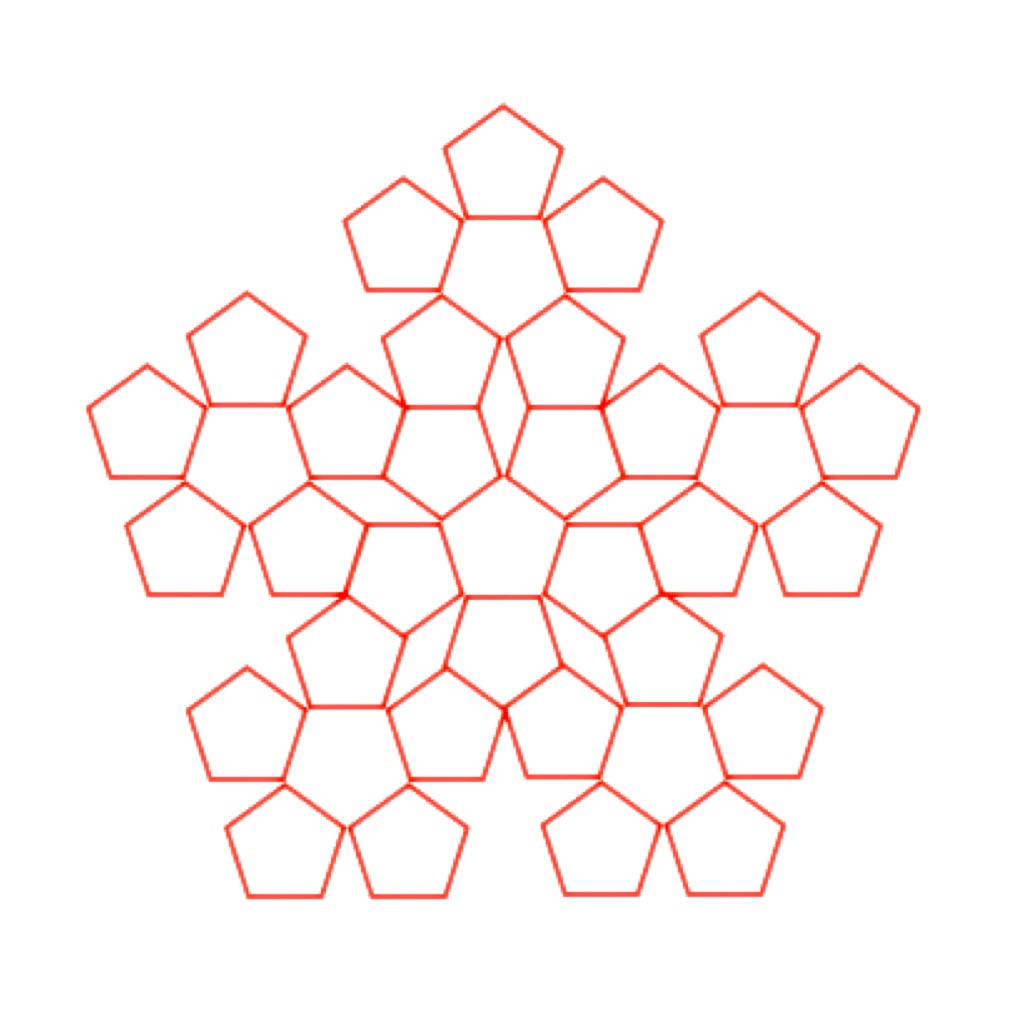
Some things only make sense when you stop looking directly at them. It starts on the floor. A quiet grid beneath your feet in a café somewhere. Tiles that don’t ask for attention, but somehow hold everything together. You step across them without thinking. Square, square, square. Or maybe hexagons, tucked neatly like a honeycomb. There’s a calm to it. A sense that something, somewhere, has already been solved. That quiet, almost invisible structure is where tessellation begins.
At its simplest, it’s just a repeating pattern, shapes covering a flat surface with no gaps and no overlaps, edge to edge, like good neighbors. In mathematics, it becomes a world of precision, polygons meeting perfectly, every angle accounted for. Nothing is wasted, and yet it doesn’t feel rigid, it feels settled.
But look closer, and the math starts to breathe. This is where something like Ma (間) begins to make sense, the space between. While the geometer sees the absence of gaps as a solved equation, the artist notices the line where two tiles meet. A relationship. A pause that makes the pattern readable. Without that thin, silent boundary, the grid would feel like a monolith. With it, the floor becomes a conversation.
The word itself carries its own history. Tessellation comes from tessella, a small square stone used in ancient mosaics. In Sumer and across the Roman world, these tiny tiles, tesserae, were placed by hand to form stories underfoot. Something close to Monozukuri, the quiet act of making with care. People walked across these floors without always noticing the complexity holding them up, precision in service of something lived-in.
Mathematicians, of course, asked which shapes could tile a plane perfectly. The first answers are reassuringly simple, regular tessellations of triangles, squares, or hexagons. Everything repeats. Everything behaves. Then the pattern loosens. Semi-regular tessellations introduce variation, like a piece of music where the tempo holds but the melody drifts.
And then, just when the system feels understood, it shifts into the aperiodic. Patterns like those from Roger Penrose cover the plane perfectly but refuse to repeat. They feel less like flooring and more like thinking itself, structured but never predictable. You can look at them for a long time and never quite find a center, because there isn’t one.
It’s tempting to leave tessellation in the abstract, but it leaks into the natural world. Honeycombs. Cracked earth. Fish scales. Each one quietly solves the same problem, how to fill space efficiently, without force. In these patterns, something like Wabi-sabi (侘寂) appears. The cracked mud isn’t a failed grid. It’s a beautiful, imperfect alignment. A chipped tile or a worn mosaic doesn’t break the pattern. It anchors it in time.
Tessellation, then, is less about shapes and more about fitting. About how individual pieces meet, adjust, and hold together without leaving gaps. There’s a quiet metaphor here. We don’t overlap too much. We don’t leave too much empty space. We find edges that match, more or less, and we build something that works not perfectly but well enough to walk across.
If you look down next time you’re waiting somewhere, you might notice it again. The quiet grid. The small decisions made long before you arrived, holding steady while everything else moves. A different kind of conversation. One where variety fits in without breaking the peace.
While the coffee is still warm.
⸻
Author’s Note
This one started because I started staring at a café floor a little too long. Where patterns stop being decorative and start feeling philosophical, which is either curiosity or just enough coffee to make tiles seem suspiciously meaningful.
At some point, I wondered if the Olympic rings came from something like this, someone absentmindedly leaving a cup on paper, lifting it, shifting it slightly, and repeating the process until five circles settled into place.
Probably not.
But it feels like the right kind of accident. A search for something that feels settled, without needing to be perfect.
Leave a Reply