
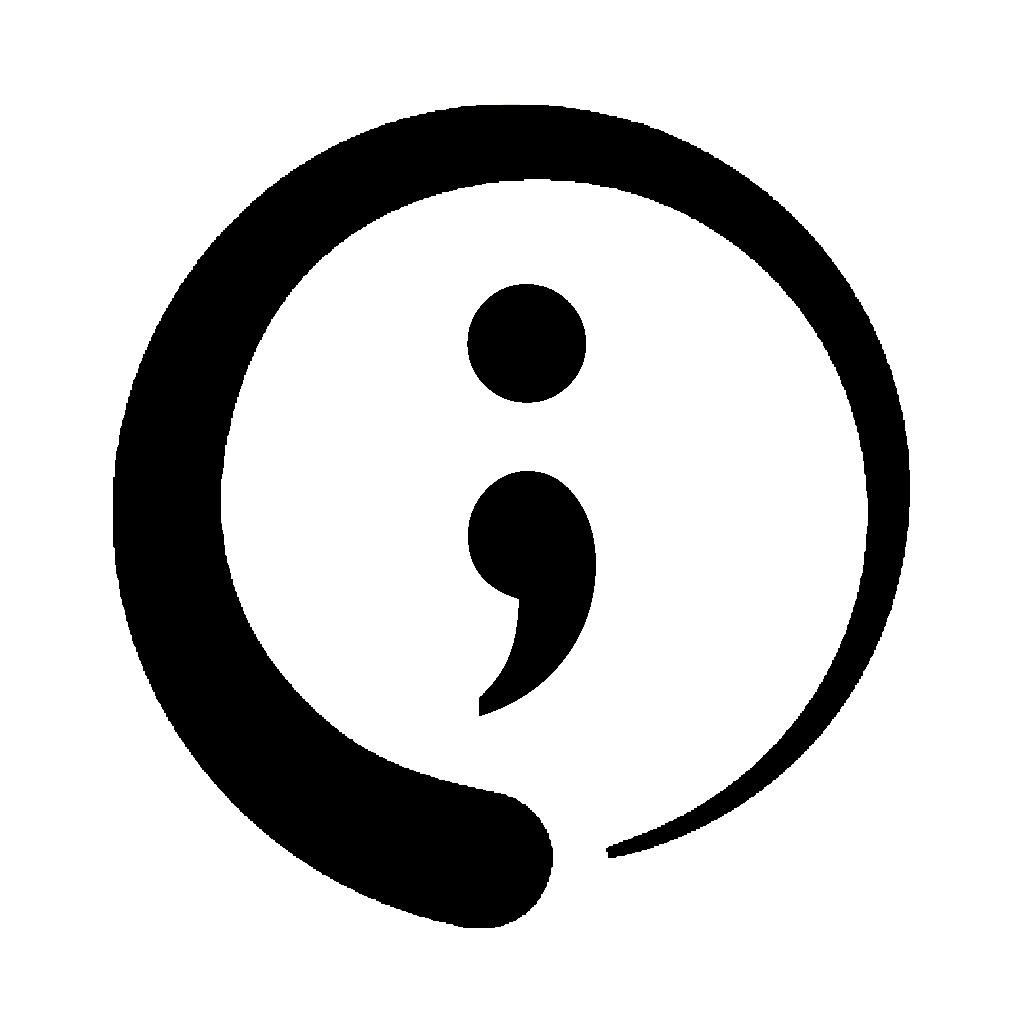
It starts with something small, so small you might miss it at first, a dot resting above a curl, like a comma that hesitated and decided to become something else. A semicolon tucked onto a wrist, behind an ear, along the side of a finger, sitting there quietly as if it belongs to the body as much as the skin itself.
At a glance, it can look unfinished, like someone stepped away mid-sentence and never came back, but that first impression doesn’t quite hold once you sit with it for a moment.
I started noticing it slowly, then all at once, the way certain things do. On students leaning over notebooks in that half-focused, half-drifting way, on musicians adjusting cables before a set while pretending not to be nervous, on friends who laugh easily but go quiet in ways that don’t always need explaining. It appears without announcement, without introduction, and often without context, just present, just enough.
On paper, a semicolon is a pause that could have been an ending, a place where the sentence had every right to stop and simply didn’t. In ink, it becomes something heavier and more personal, less about grammar and more about decision, about the quiet moment where stopping was possible and continuing was chosen instead.
The symbol found its way into the world through Project Semicolon in 2013, beginning as a small gesture passed from hand to hand across social media, where people drew a semicolon on their skin, took a photo, and shared it as a way of saying, without too much ceremony, that they were still here and that others were not alone either. It was never meant to be permanent, which is probably why so many people chose to make it so.
Grammatically, the semicolon works as a hinge, holding together two thoughts that could stand apart but feel better when they don’t, allowing a sentence to continue where it might otherwise have ended. That idea settled into something more human over time, the simple and slightly disarming notion that you are the author and your life is the sentence, which sounds like something you would roll your eyes at until you realise how many people are quietly holding onto it.
For some, the tattoo becomes a promise made privately, something you return to without needing to explain it to anyone else. For others, it carries memory, a way of holding someone close in a mark that refuses to let their story feel finished, even if it no longer unfolds in front of you.
It would be easy to dismiss it as a trend, a minimalist symbol that found its moment and stayed a little longer than expected, but that reading tends to fall apart the closer you get. These marks live in places that feel deliberate, the inside of a wrist where the pulse sits close to the surface, the side of a finger that moves through everyday gestures, the quiet spaces that are seen often but rarely announced.
I remember noticing one on the back of someone’s hand as they reached for a coffee cup, the kind of absent-minded movement you don’t usually pay attention to, except this time it lingered just long enough to register. Neither of us said anything, which in hindsight felt appropriate, because not every symbol is an invitation, and not every pause needs to be filled.
I had a cup of tea beside me while writing this, the kind you forget about halfway through and return to later, only to find it has gone cold but is still somehow fine, still drinkable, still itself. Coffee does the same thing in its own way, cooling, pausing, waiting to be picked up again, which feels strangely appropriate for something that is not about stopping, but about continuing in a slightly different state, or at least like a decent excuse for how many half-finished cups tend to gather around me.
That might be where the semicolon does its best work, not in what it declares, but in what it allows. It creates a small opening, just enough for a conversation to begin if it needs to, or just enough for recognition to pass quietly between two people who understand it without needing to unpack it.
It sits somewhere near other small gestures, a note left where it will be found later, a song sent without explanation, a message that arrives late at night and says very little but means more than it should. Not a slogan, not a performance, but something closer to a signal that says, in its own quiet way, I am here, I have been somewhere, and I am still going.
There is something fitting about choosing a mark that never quite finishes what it starts, something that leans forward rather than closing itself off. As a tattoo, it becomes a kind of bookmark, not at the end of a chapter but somewhere in the middle, holding a place that might otherwise have been lost, reminding you that the story did not stop where it could have.
If you notice one, it can feel like catching a line from a song you didn’t realise was playing, something soft but unmistakable once you hear it, and if you happen to be the one carrying it, it tends to feel less like a declaration and more like a quiet agreement with yourself.
The sentence could have ended, and for a moment it might even have felt like it would, but it didn’t, and that small decision, repeated over time, is what keeps the line moving forward.
⸻
Author’s note ;;;
This one took its time, written between sips of tea that went cold more than once, and a coffee that I’m fairly sure I reheated at least twice, which feels about right for a piece about pauses that don’t quite end. It turns out even drinks understand the semicolon better than we do and yes, the 3 ;;; are not a typo …
Leave a Reply