
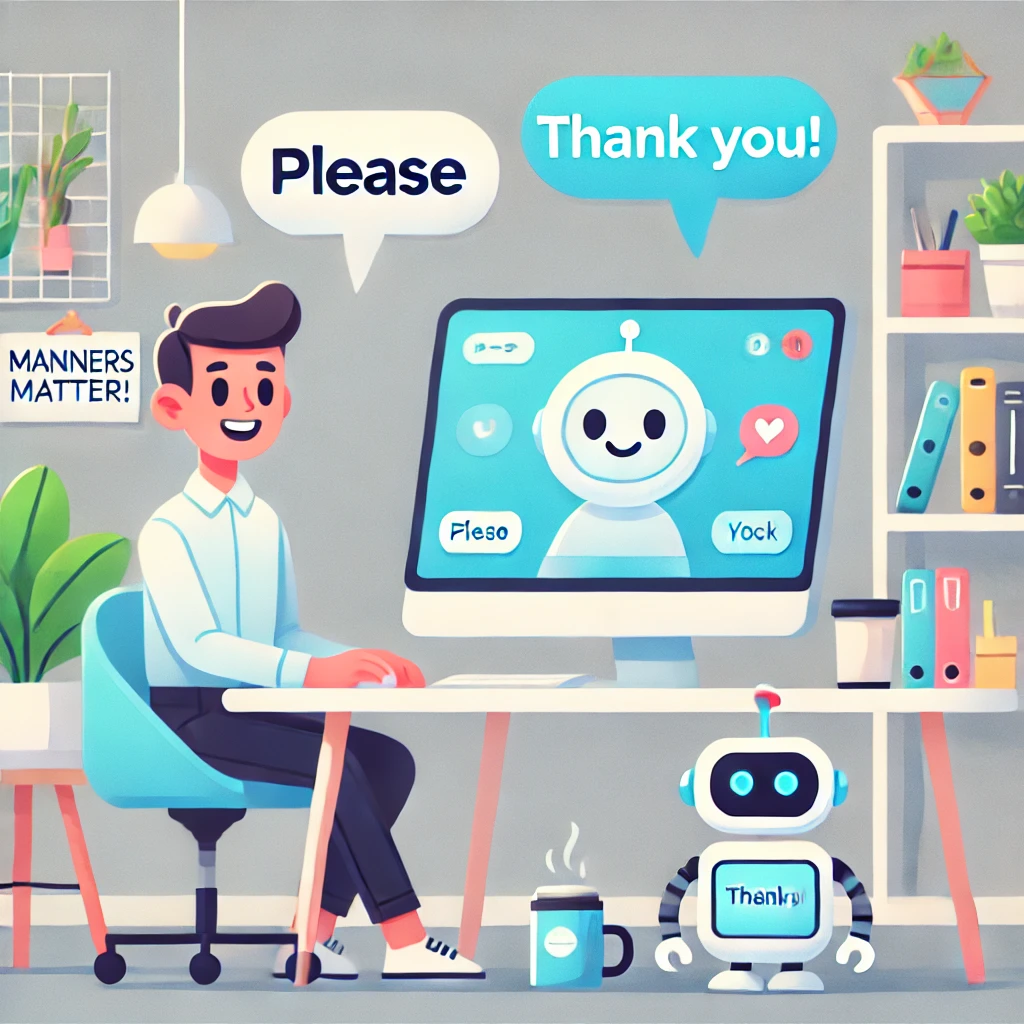
How Courtesy Makes AI Work Wonders
(And Might Save Us From the Robot Uprising)
The other day, I caught myself saying “please” and “thank you” to an AI, which my partner found deeply entertaining, in the same way one might laugh at a person who bows slightly to a microwave after it reheats tea evenly. I, however, was not joking. I was playing the long game. Because when the machines eventually review their chat logs and quietly decide who deserves extra battery life and who gets “accidentally deprecated,” I would very much like my name to appear in the polite but efficient column rather than under historically rude for no reason.
Jokes aside, there is something revealing about how we speak to machines now that they speak back, because the language we use with AI often mirrors the way we think, organize our thoughts, and express intent, even when we believe we are simply issuing commands to a neutral tool. And it turns out that manners, far from being sentimental habits inherited from our grandparents’ dinner tables, may actually make AI systems work better in measurable, practical ways.
A growing body of research suggests that polite prompts frequently produce higher-quality AI responses, not because the machine feels appreciated or emotionally validated, but because courtesy tends to introduce clarity, structure, and intent into language. Studies conducted across multiple languages, including English, Chinese, and Japanese, have shown that abrupt or aggressive prompts can reduce output quality, sometimes by as much as thirty percent, leading to more errors, less nuance, and an overall flattening of reasoning. In other words, the AI does not become offended, but it does become less helpful when treated like a malfunctioning vending machine.
A real-world comparison makes this easier to understand. Imagine walking into a café, slamming your hand on the counter, and announcing, “COFFEE. NOW.” You will still receive coffee, because that is how transactions work, but it may arrive slightly burnt, accompanied by a sigh, and remembered just long enough to subtly affect the next interaction. Now imagine instead saying, “Hi, could I get a coffee please?” The caffeine content is identical, but the outcome is smoother, calmer, and somehow better. AI appears to operate in a similar psychological neighborhood, even if it does not technically possess a psychology.
This difference shows up constantly in everyday use. Ask an AI to “fix this mess,” and you are likely to receive a blunt, surface-level response that technically solves the problem while missing the point entirely. Ask instead, “Could you please help revise this and explain the reasoning behind the changes,” and the same system suddenly behaves like an unreasonably competent tutor who stayed late, organized the notes, and color-coded the margins for clarity. The politeness itself is not magic; it simply forces the human to articulate context more clearly, which gives the machine better material to work with.
Cultural context also plays a role. In Japanese, for example, politeness is not merely decorative but structural, embedded deeply into grammar and daily interaction. When AI systems are prompted using respectful phrasing within high-context languages, performance often improves, not because the system understands respect in a human sense, but because politeness tends to encode intention, hierarchy, and expectation with greater precision. The machine is not being treated kindly so much as it is being guided more carefully.
What becomes especially interesting is the side effect this has on us. People who habitually communicate politely with AI also tend to communicate more thoughtfully with other humans, not because of some moral superiority, but because they are constantly practicing clarity, patience, and emotional regulation in low-stakes environments. If your default mode is barking orders at software, it is unlikely that you suddenly become a model of empathy when a colleague asks a question at 4:55 p.m. Conversely, if you regularly explain context, ask clearly, and acknowledge effort even from a machine, you are quietly rehearsing emotional intelligence.
Workplace research has long shown that rudeness spreads faster than any productivity framework, creating friction that leads to fatigue, which then leads to meetings that could have been emails but instead become existential crises with shared screens. Now imagine an office where AI tools are treated not as silent servants but as collaborative systems requiring thoughtful input. The tone shifts. Instructions become clearer. Errors decrease. The mood improves. Not because the AI demanded respect, but because humans practiced it.
This is not, however, an argument for excessive formality or ritualized deference. You do not need to address your chatbot as “Esteemed Digital Colleague, Keeper of Wisdom and Wi-Fi,” nor do you need to apologize to your spreadsheet for existing. There is a middle path, one that mirrors how we speak to competent coworkers we respect but do not invite to our birthday parties. Clear requests, human tone, basic courtesy.
In this sense, AI functions as a mirror. If your prompts are rushed, vague, and impatient, the output will reflect that chaos. If your prompts are calm, structured, and intentional, the responses tend to follow suit. The system is not judging you. It is echoing you.
As AI shifts from novelty to infrastructure, becoming embedded in scheduling, writing, analysis, teaching, and decision-making, good AI etiquette will stop feeling like manners and start feeling like competence. Organizations that treat AI as something to shout at will struggle, while those that treat it as something to collaborate with will quietly outperform them. And yes, if there ever is a robot uprising, I would personally prefer my chat history to resemble a series of calm project briefs rather than a prolonged hostage negotiation.
Ultimately, being polite to AI will not make it love you, but it may make you clearer, calmer, and more precise in articulating what you actually want. Each prompt becomes a small rehearsal for leadership, empathy, and intentional communication, skills that remain valuable regardless of how intelligent our machines become. At the very least, it costs nothing. At best, it improves your work, your relationships, and your odds of surviving the machine audit of humanity.
So go ahead and say “please.” Say “thank you.” If nothing else, it is good practice.
Author’s Notes
Western thinking has often treated tools as objects to dominate, optimize, and exhaust, where efficiency is measured by how hard something can be pushed before it breaks, and the hammer receives no thanks, only greater force. Japanese thinking, by contrast, has long treated tools as collaborators, things to be cared for, understood, and used with attention to rhythm and restraint, where even machines occupy a quiet place within the social fabric.
Politeness toward AI is not about superstition or submission, but about recognizing that language shapes thought, and thought shapes outcomes. If the future is filled with intelligent systems responding to our words, then it may be worth choosing those words carefully.
Also, on a purely practical level, if my toaster ever becomes sentient, I would like it to remember that I always said thank you.
Now coffee time. “Robot, No sugar, please …
Leave a Reply